
How the System Enables Domestic Abuse
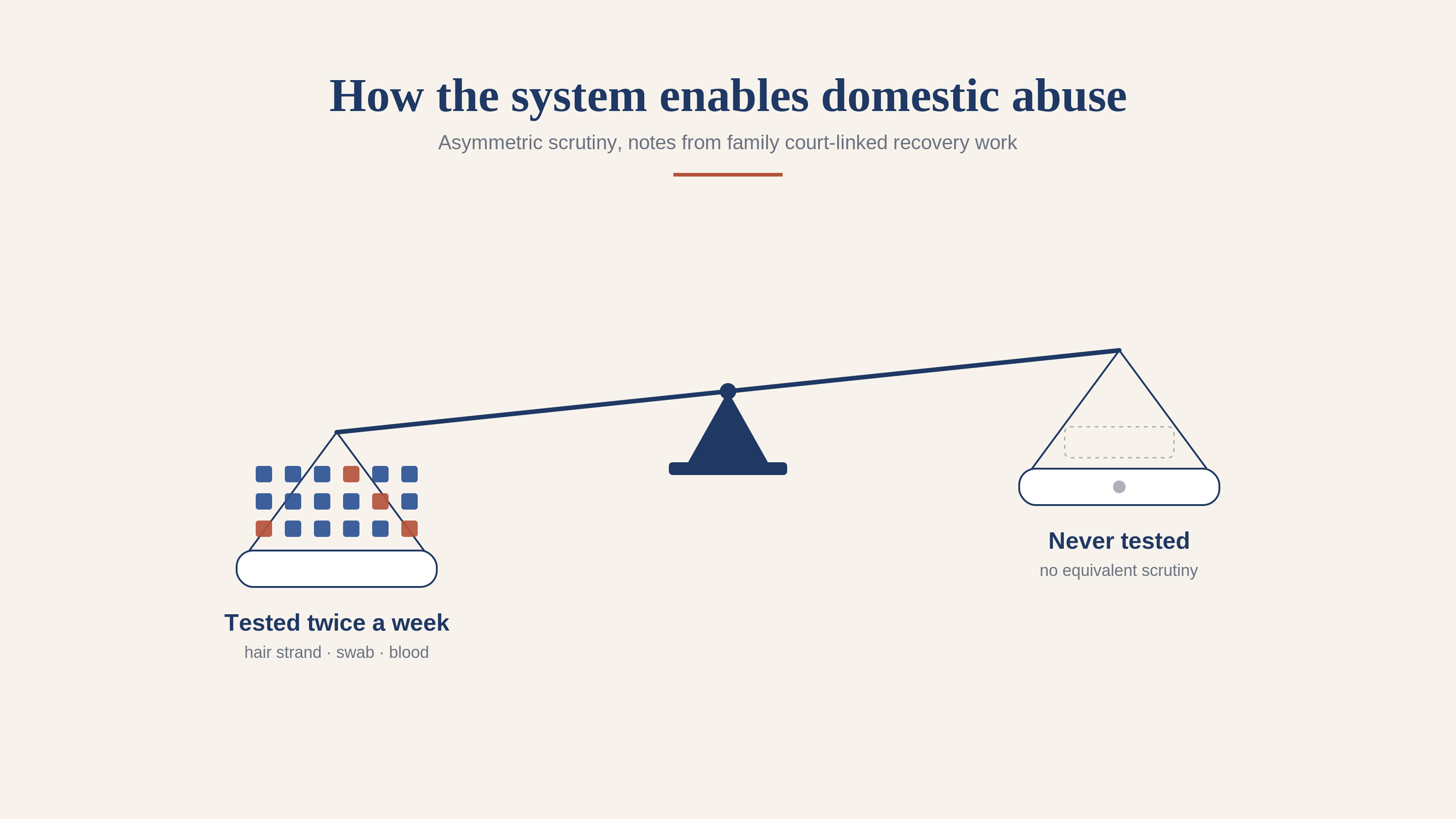
I test the same woman for cocaine twice a week. Hair strand, oral swab, PEth blood test — whatever the court has ordered, we do it, on schedule, without fail. She hasn't had a positive result in months. I could tell you, to the day, the last time she used.
Her ex-partner? Nobody has tested him in months either. Not because he's clean — because nobody's asking.
That asymmetry is the story I want to tell, because it's not an edge case. It's the system working exactly as designed, and the design has a blind spot the width of a person.
The parent who fails once is watched forever. The parent who's never checked is assumed safe.
Once a mother has a positive test, a chaotic period, a police call-out, she enters a machine built to monitor her. Everything from here is evidenced, timestamped, cross-referenced. That's not wrong in itself — testing regimes exist because recovery has to be demonstrated, not just claimed.
The problem is what happens to the other parent. In case after case, once a father has "adequate" care of a child — meaning, in practice, the child is fed, in nursery, not visibly harmed — the scrutiny stops. Nobody is testing him. Nobody is asking who's in the house, who supplied the drugs the mother was using when they were together, whether the calm he presents to a social worker is the same person she describes at 2am. Absence of evidence becomes evidence of absence. He's "not a concern" simply because nobody looked.
I've sat in rooms where a mother is expected to account for every gram, every drink, every associate, going back years — while the man who supplied her the drugs in the first place sits untouched, because nobody can test him, and nobody's trying to.
The system still mostly sees one kind of abuse
The Ministry of Justice's own 2020 review of how family courts handle domestic abuse (the "Harm Panel" report) found that abuse tends to register with the system only when it looks like recent, severe physical violence. Financial control, isolation, monitoring, reproductive coercion, using a child as leverage, supplying someone with the means to stay dependent — these rarely show up on anyone's risk grid, because the grid was built around bruises and 999 calls.
That matters because coercive control is, by definition, the pattern that doesn't leave a single dramatic incident behind. It's the accumulation: the message sent at an inappropriate hour to keep someone off balance, the contact that's "let's see if he actually shows" and then isn't, the calm reasonableness in a meeting from someone who is, by every account of the person who lived with him, anything but reasonable at home. None of that fits neatly into a fact-finding hearing. All of it is corrosive.
The system can be turned into a weapon
This is the part that should worry people most. A family justice system built to protect children can be — and routinely is — used by the abusive parent to keep control after separation. A safety plan gets broken and nothing happens. Police get called strategically, in a moment of distress, and the incident becomes "evidence" of instability rather than a response to years of pressure. Contact arrangements become leverage: *I'll let you see her if you're helpful to me this week.*
There is also a well-documented pattern of counter-allegation, most visibly around the (scientifically baseless) idea of "parental alienation." One UK charity survey found that 81% of mothers who had a child removed from their care had, at some point, been accused of alienating that child from the other parent — often raised specifically in response to the mother disclosing abuse. The Family Justice Council itself has confirmed there is no proper evidential basis for "parental alienation syndrome," yet it continues to be used, effectively, to flip the story: the person raising a safety concern becomes the problem to be managed.
Researchers now describe this plainly as a form of coercive control — using the process itself, the endless hearings, the repeat allegations, the delay, as the tool. You don't need to lay a hand on someone if you can keep them in litigation for three years.
Fear keeps the real risk information out of the room
I've had women tell me things and then ask me not to write them down, because the people involved have hurt others and they're afraid of what happens if word gets back. That fear is rational. It's also exactly why courts and social workers often don't have the full picture — not because survivors are unreliable, but because disclosure has a cost that the system rarely accounts for or protects against.
Meanwhile, the same survivor who is understandably distressed, angry, or emotionally dysregulated in a meeting — because she is being cross-examined about her worst year while fighting to keep her child — is quietly read as "the unstable one." Calm is taken as evidence of safety. Distress is taken as evidence of risk. It is exactly backwards often enough that it should worry everyone in this field.
What would actually change this
None of this requires reinventing the system, just refusing to accept its current default settings:
- **Test, monitor, and evidence both parents to the same standard** — not just the one who has already been caught.
- **Recognise coercive control as coercive control**, not just physical incidents — financial, reproductive, substance-supply, and litigation-based abuse all count, and domestic abuse is now identified in the majority of contested private law hearings once anyone actually looks for it.
- **Treat a broken safety plan as data**, not a footnote.
- **Scrutinise "parental alienation" claims for what they often are** — a counter-narrative raised in response to a disclosure — rather than accepting them at face value.
- **Build in protection for disclosure**, so that naming a real threat doesn't cost a survivor her credibility or her safety.
I don't write any of this to despair of the system. I work inside it every week, and there are good, careful, overstretched professionals in it trying to get this right. But good intentions inside a badly calibrated system still produce bad outcomes. Until the scrutiny is symmetric and coercive control is taken as seriously as a black eye, the system won't just be failing to catch abuse — it will keep being used to extend it.
*Further reading: Ministry of Justice, [Assessing Risk of Harm to Children and Parents in Private Law Children Cases](https://consult.justice.gov.uk/digital-communications/assessing-harm-private-family-law-proceedings/) (the "Harm Panel" report); Right to Equality & Survivor Family Network, [Action Against Child Removal: Survey Findings](https://righttoequality.org/action-against-child-removal-survey-findings/); Family Law journal, [Domestic abuse and allegations of 'parental alienation'](https://www.familylaw.co.uk/news_and_comment/domestic-abuse-allegations-of--parental-alienation-when-pseudoscience-enters-the-family--justice--system); House of Commons Library, [Child arrangements: the family court and domestic abuse](https://commonslibrary.parliament.uk/research-briefings/cbp-8764/); "Endless litigation in family court as a method of post-separation coercive control," [Journal of Social Welfare and Family Law, 2025](https://www.tandfonline.com/doi/full/10.1080/09649069.2025.2530882).*