
A reflection on introducing Internal Family Systems therapy
There are sessions where a model, a framework, a way of seeing the world lands differently than you expect.
Not because the person hasn’t heard similar ideas before, but because in that particular moment, in that particular room, something clicks. This was one of those sessions.
Sarah has been working through an extraordinarily complex set of circumstances — a child removed from her care, a legal process that feels relentless, a history of relationships with controlling partners, and the long shadow of alcohol as a coping strategy. She is, by any measure, under sustained pressure. And yet she shows up. Every session. Honest, searching, and genuinely trying to make sense of herself.
This week, we began to map her Inner Family System.
What Does “Inner Family System” Actually Mean?
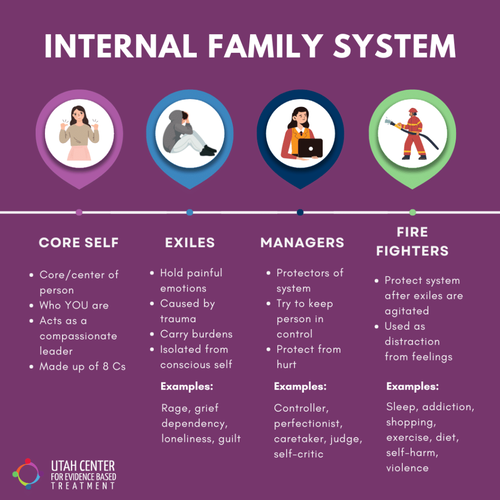
Rooted in Jungian psychology and developed by Richard Schwartz, IFS invites us to understand the psyche not as a single, unified self — but as a system of “parts.” Each part has a job. Each part developed for a reason. And here is the critical insight that I always want clients to take hold of first: there are no bad parts. None. Not even the ones we’re most ashamed of.
At the centre of this system is the Self — the core of who a person is. Calm, curious, compassionate, connected. The Self doesn’t cause harm. The Self doesn’t drink, doesn’t people-please, doesn’t make a phone call it knows it shouldn’t. The parts do those things. And they do them because, at some point in that person’s history, those behaviours were the most reasonable response available.
The Parts We Found in the Room
As Sarah and I talked, we began to sketch out her system together. A simple drawing — the Self at the centre, parts arranged around it. Here is what began to emerge:
The Abandoned Part. When Sarah was twelve, her parents separated. At that age, the departure of a parent doesn’t register as an adult decision — it registers as abandonment. A part developed to carry that wound. This part is still there. She shows up in relationships, in that pull toward people who may leave, in the hypervigilance about being believed.
The People-Pleasing Part. Sarah described being the “underdog” growing up — overshadowed by a high-achieving sister, always working harder to be liked. This part learned early that love is earned through compliance, agreeableness, and making others comfortable. She is exhausting to live with, this part, because her standards are never quite met.
The Exiled Part (formerly the Drinking Part). Alcohol, for Sarah, was not a choice in any simple sense. It was a part that stepped in when the emotional load of abusive relationships became too heavy to carry. “She’s protecting you,” I said. “She’s saying: you can’t handle what’s happening, so let me help.” This part is now largely exiled — kept quiet by the significant work Sarah has done. But exiled doesn’t mean gone. It means she needs tending to with care, not condemnation.
The Scared Part. This one was vivid in the session. Sarah described a recent phone call from her daughter’s father — an unexpected voice call, outside the agreed communication channel. She answered it, heard the reason, and shut it down. A small thing. But afterward, the Scared Part flooded the room: “I’m going to be in trouble. This will be used against me. I’m going to lose her.” We spent time with this part — not dismissing her, but understanding her. She answers the phone because she’s terrified. Not because Sarah is weak.
The Firefighter Part. When Sarah felt that others weren’t believing her — particularly professionals involved in her case — a reactive part emerged mid-session, urgently trying to strategise how to change their minds. IFS calls this a firefighter: a part that tries to douse the fire of overwhelming emotion, often impulsively and at great cost. I named it gently. She recognised it immediately.
The Talkative Part. This one made Sarah laugh. She knows her. The part that fills silence with words when difficult things are approaching. Not avoidance exactly — more like armour. If I keep talking, maybe the hard thing won’t land.
When Parts Take Over: Blending
In IFS, we talk about “blending” — the moment when a part fuses so completely with the Self that they become indistinguishable. You don’t think the Scared Part is afraid; you are afraid. You don’t notice the Firefighter activating; you simply find yourself five minutes into a strategy session that nobody asked for.
Recognising blending is one of the most important skills in this work. And it is a skill — it develops with practice, with noticing, with a therapist who will sometimes say: “I see a part in the room right now. Can we talk to her?”
I do this work with my own parts too. I told Sarah as much. Sitting in a multi-agency meeting, being the only clinician in the room — a defensive part of mine wants to speak loudly, to correct, to assert. I have learned to say to that part: “I see you. Sit down. You’ll get your turn.” None of us are exempt from this.
The Value of a Small Win
Something else happened in this session that I want to hold onto. Sarah told me, with genuine lightness, that she’d been given permission for a day out with her daughter next month. A trip to a theme park. Something ordinary, something millions of families take for granted.
“It seems so stupid,” she said, “but that, for me right now, is a massive win.”
It isn’t stupid at all. After months of supervised contact, legal proceedings, professional scrutiny, and the daily grind of proving yourself worthy of your own child — an afternoon at a dinosaur park is enormous. We have to take these wins. We have to let them mean what they mean. The work of recovery, and especially of child protection proceedings, is relentlessly focused on what is still wrong, what is still needed, what is still missing. Making space for what is going right is not naive optimism. It is protective.
The Homework: Mapping the Inner Family
I gave Sarah a simple task for the week ahead. Draw the diagram. Put the Self at the centre. Then begin to name the parts she can identify — not just the ones we found today, but others that emerge in quiet moments, in difficult situations, in the gap between what she wants to do and what she finds herself doing.
She doesn’t need to understand them all. She just needs to start noticing them. To say, “Oh — there’s the Scared Part. I recognise you.” That noticing, that tiny moment of distance between the Self and the part, is where everything begins.
A Final Thought
There is a moment in every IFS introduction where I watch something shift. It’s the moment when a client stops seeing their most problematic behaviour as evidence of their own badness, and starts to see it as evidence of a part that was trying, in the only way it knew how, to keep them safe.
For Sarah, that moment came when we talked about the phone call. About the part that answered because she was terrified. I watched her face change — not relief exactly, but something close to it. The beginning of self-compassion.
That is the work. Not absolution. Not excusing. Understanding.
All identifying details have been changed to protect client confidentiality. This post is a reflective narrative and does not constitute clinical advice.