
Which Part of You Is Saying Yes?
A Reflection on Self-Leadership, Contact Decisions, and the Complexity of Being a Mother in Recovery
In a recent session, my client — I'll call her Sara — arrived carrying something heavy. Not just the practical weight of an upcoming decision about her daughter's contact with her former partner, but the internal noise of multiple parts all speaking at once, each with its own logic, its own fear, its own version of the right answer.
This is, I think, one of the most honest illustrations of what IFS work looks like in a family court context. It isn't tidy. The parts don't queue politely. They interrupt each other. And somewhere underneath all of them — quieter, steadier, but very much present — is Sara herself.
The Protective Part
Sara has a part that sees clearly. It notices that her former partner, Dan, brings nothing to the table in terms of demonstrated safety. He is not being tested. He is not in treatment. He is still using. Sara, by contrast, is tested twice weekly — bloods, urine, hair strand — and is engaged with intensive support.
This part says, without apology: I don't need to make excuses for him. That's his work, not mine.
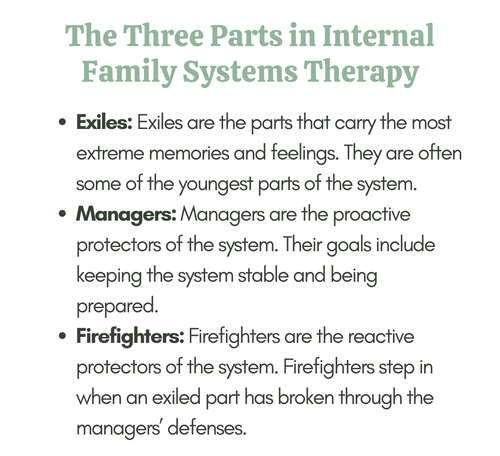
In IFS terms, this is a protector doing exactly what protectors do — assessing risk and trying to keep the system safe. My job in the session was to validate this part, speak directly to it, and help Sara trust it as a reliable guide rather than dismiss it as harshness or selfishness.
The Compassionate, Addiction-Informed Part
But Sara also carries a part shaped by her own history with addiction and by the devastating experience of separation from her older son, Luca. This part knows how it feels to be the parent on the other side of a closed door. It remembers that heartbreak with her whole body.
This part understands that addiction is ruthless — that it doesn't wait for a convenient moment, that it doesn't care about hair strand tests or supervised contact arrangements. And yet it still worries: What if contact could be a motivator for Dan to change?
There is nothing wrong with this part. Its compassion is real and hard-won. But compassion, as I said to Sara, is a limited resource. When someone is not yet evidencing change, pouring empathy into them can drain the very reserves Sara needs for herself and her daughter.
The People-Pleasing Part
Then there is the part that worries about what others will think. Will Dan's family say she's being difficult? Will the court see her as obstructive? Will social workers think less of her for refusing contact?
This part is not shallow. It was formed in an environment where Sara's sense of safety was tied to how others perceived and responded to her. It learned that conflict brings consequences, and that being liked offers a degree of protection.
I asked it directly: What do you fear will happen if the protective part leads?
The answer was honest: I don't want to be blamed. I don't want conflict. I want people to think well of me.
I thanked the part for that honesty, and then I invited Sara's Self to hold it — to let it be heard without letting it drive.
The Rationalising Part
Sara has a remarkable intellect, and she has a part that knows exactly how to use it. This part can explain the shit out of anything — her words, and I think they're worth keeping. It constructs legal arguments, anticipates professional responses, and produces plausible-sounding justifications for decisions that her gut knows aren't right.
I noticed it in the session when Sara began working through what the court might think, what a compliant response would look like, whether refusal would score against her in proceedings. All legitimate questions — but being asked at the wrong moment, by the wrong part, to override something more fundamental.
When the rationalising part jumps in quickly enough, it can talk Sara out of her own protective instincts before she's even had time to notice them. Part of our work is simply slowing that process down: Which part is speaking right now?
The Idealising Part
This one is subtle, and it matters. There is a part of Sara that wants her daughter to have the father she herself never had — stable, present, safe. This part doesn't see Dan as he currently is. It sees a wished-for version: the dad who could step up, get clean, be there.
I named this gently in session: Sara carries grief for the father she never had, and that grief can project itself onto Dan — wanting him to be what he isn't yet capable of being, at a cost to her daughter's safety and her own.
This isn't weakness. It's deeply human. But it needs the Self to hold it rather than let it set the course.
The Question That Keeps Coming Back
Throughout the session, I kept returning to one question whenever we were talking about the proposed supervised contact in another town: Which part of you is agreeing to this?
Not as a challenge. As a genuine inquiry. Because the people-pleasing part will say yes to avoid conflict. The rationalising part will construct a case for compliance. The idealising part will say yes because it still believes in the storyline where Dan becomes the dad. And the compassionate part will say yes because it remembers what it felt like to be Dan.
The only part I want leading that decision — the only part I trust to lead it — is Sara's Self. And Sara's Self, when it has the space to speak, says: Who does this actually help right now?
Usually, the honest answer is: not Artemis. Not Sara. Not the recovery. It helps Dan feel better for a day.
Sara's Emerging Self
What struck me most in this session was how visible Sara's Self has become. She can name her parts. She can catch herself mid-rationalisation. She can hold compassion for Dan and hold a clear risk assessment at the same time — not because she's suppressed one part, but because her Self is big enough now to contain the whole system.
She said something I want to hold onto: I'm working so hard to find myself. I'm making a decision to keep my daughter safe.
That is Self-leadership. That is what FDAC is for — not to make the decisions for Sara, but to build the internal capacity so that she can make them herself, clearly and with confidence, once the system steps back.
She is almost there.
A Note on What Comes After
When Sara returns home with her daughter, there will be no social worker in the room. No drug tests ordered by a court. No formal safety net. There will just be Sara — her parts, her Self, and her child.
My confidence in recommending reunification rests on what I have seen develop across our work: a woman who no longer reacts from her most frightened parts, who can pause, notice, reflect, and choose. That is an extraordinary thing to witness.
The work isn't finished. But the foundation is solid.
This post is anonymised and published with the spirit of the work in mind. All names, identifying details and family configurations have been changed. Clinical themes are shared to illustrate IFS-informed practice within a family court and recovery context.