
Understanding Emotional Flooding and Finding Your Way Back
We’ve all been there. A message arrives, a phone call comes in, someone says something unexpected —
and within seconds, we’re overwhelmed. Heart racing, thoughts scattered, the ability to think clearly gone. It can feel like we’ve been hijacked.
In therapy, we call this emotional flooding. It is not a character flaw, a sign of weakness, or evidence that something is “wrong” with you. It is your nervous system doing exactly what it was designed to do — trying to protect you from threat. The problem is, that same protective system does not always know the difference between a genuine danger and a difficult piece of news.
The Window of Tolerance
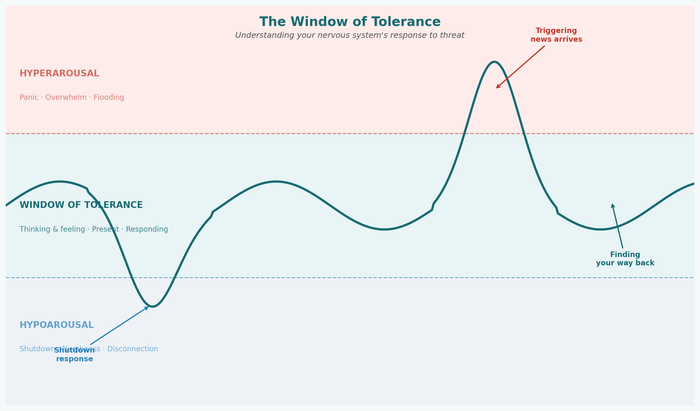
Psychologist Daniel Siegel coined the term “window of tolerance” to describe the zone in which we can function at our best. Inside that window, we can feel emotions without being overwhelmed by them. We can think and feel at the same time. We can respond thoughtfully rather than react automatically.
When something triggers us — particularly something that connects to old pain, loss, or fear — we can be pushed outside that window in an instant. We either flood upward into panic, hypervigilance, and overwhelm, or we shut down into numbness and disconnection. Neither state is a failure. Both are survival.
The nervous system is especially primed to respond to threats to the things we love most — our children, our security, our sense of self. When something appears to threaten those things, even a brief, unexpected message can set off a full alarm response. Because the system is not evaluating the message in isolation. It is responding through the lens of everything that has come before.
“Neither state is a failure. Both are survival.”
An IFS Perspective: Understanding Your Parts
Internal Family Systems (IFS) therapy offers a powerful way of understanding what happens in these moments. According to IFS, we are not a single, unified self — we are a family of inner parts, each with its own role, its own history, its own way of trying to keep us safe.
When we are flooded, it is usually because an exile — a part carrying old pain, fear, or grief — has been touched. The exile does not live in the present. It lives in the moment the original wound happened: the first time safety was taken away, the first time a promise was broken, the first time we felt truly powerless. When a present-day event echoes that old wound, the exile responds as if it is happening all over again.
Around the exile, protector parts rush in. These are the parts that panic, freeze, go into overdrive, or shut down — all in an attempt to prevent the exile from being overwhelmed. The panic you feel is not irrational. It is a protector trying desperately to keep you safe.
Understanding this does not make the panic disappear. But it does begin to change your relationship with it. Instead of fighting the alarm, you can start to get curious: which part of me is in distress right now? What is it afraid of? What does it need?
What Helps: Co-Regulation Before Self-Regulation
When we are flooded, the thinking brain — the prefrontal cortex — largely goes offline. This is why “just calm down” or “think rationally” rarely works in the middle of a crisis. You cannot reason with a system that has moved into survival mode.
What actually helps is co-regulation: the calming presence of another person whose own nervous system is settled. Research consistently shows that the most powerful regulator of the human nervous system is another calm nervous system. This is why safe therapeutic relationships matter so much — not just as a space to talk, but as a place to learn, through repeated experience, that it is possible to come back from the edge.
In practice, co-regulation can look like someone slowing their speech and lowering their voice. Someone staying present with the panic rather than trying to fix it. Someone naming what they are both witnessing with compassion: “Something in your system has just gone into full alarm — that makes complete sense.” The goal is not to stop the feeling. It is to widen the window — so that over time, you can hold more, tolerate more, and return to yourself more quickly.
“The goal is not to stop the feeling. It is to widen the window.”
The Work of Recovery
For people in recovery from substance use, emotional flooding is one of the most significant relapse risk factors. Substances are extraordinarily effective at managing the overwhelm of an activated nervous system. They work — until they stop working, and until the cost becomes unbearable.
Part of what we do in therapy is build an internal infrastructure: a growing set of relationships with your own parts, a deepening capacity to be with difficult feelings, a connection to the part of you that can observe and respond rather than simply react. IFS calls this Self-energy — the calm, curious, compassionate presence that lives in all of us, even when it feels very far away.
When flooding happens — as it will, because life does not stop being difficult just because we are working on ourselves — the question becomes not “how do I stop this from happening?” but “how do I find my way back?”
That is the work. And it is worth it.
Paul Burrows is a Drug & Alcohol Counsellor specialising in trauma-informed therapy, Internal Family Systems (IFS), and recovery support. If you would like to find out more about working together, please get in touch.